

When Your Dog Needs More Calories: How to Add Weight Without Adding Volume
There are moments in a dog’s life when the scales tell you something needs to change — and fast. Not because of poor feeding, not because of neglect, but because the dog’s circumstances have pushed their caloric demand beyond what a normal meal schedule can meet. Knowing how to respond to that quickly, and safely, is part of working with dogs properly.
Over 40 years, I’ve had to put weight on dogs for more reasons than I can count. Here are the situations I see most often.
Stress-driven weight loss
Dogs under significant stress burn calories at an alarming rate. A dog that’s been rehomed, has spent time in kennels, or has gone through a change in environment will often drop condition faster than you’d expect — even when eating well. The cortisol response is metabolically expensive. By the time the dog settles and starts absorbing nutrition properly again, they can look noticeably thinner than when they arrived. This is one of the most common scenarios we deal with in residential training — dogs arriving stressed and lean, needing to recover both mentally and physically.
Post-illness and post-surgery recovery
A dog that’s been unwell, had surgery, or spent time on restricted activity often loses muscle mass and body condition. Appetite is frequently suppressed during recovery, and yet the body’s demand for protein and calories for tissue repair is actually elevated. Getting quality calories in without forcing volume on a dog with a compromised appetite is a real challenge.
High-output working and sport dogs
Any dog doing serious work — IGP, protection, police work, scent detection, or intensive training programmes — is burning significantly more than the average pet. In competition preparation, dogs working multiple sessions daily can struggle to maintain condition on standard feeding alone, especially the leaner, high-drive breeds. A Malinois in full training is a different metabolic proposition to a Labrador on the sofa.
The hard-keeping breeds
Dobermanns, Greyhounds, Whippets, and other sight hounds are notorious for being difficult to hold weight on. Their metabolism, combined with a naturally lean frame, means any additional output — training, stress, cold weather — can show up on their ribs within days. These are the breeds where you need practical tools, not just bigger portions.
Lactating and whelping bitches
The caloric demand on a nursing bitch is extraordinary. She’s feeding herself and a litter, and her condition can deteriorate rapidly in the early weeks. Increasing meal volume isn’t always the answer — a bitch with a full litter doesn’t necessarily want to eat a huge meal, and a distended stomach is uncomfortable when she needs to lie with puppies.
Elderly dogs with reduced appetite
Older dogs can lose muscle mass and condition even when apparently eating well. Reduced digestive efficiency, lower appetite, and the energy cost of managing age-related discomfort all contribute. Adding caloric density to smaller meals becomes the goal rather than pushing volume.
The secret sauce
Many years ago, Julie was having a conversation with an older and more experienced lady from rescue about the difficulties of keeping weight on a young Dobermann. She shared her advice — including a recipe that has become one of our go-to options ever since.
She called them Satin Balls. If you’ve been in dogs long enough, you’ll already know the name — they’re part of the old school toolkit, passed down through rescue and working dog circles for decades. The name has stuck for good reason. So has the recipe.
These are calorie-dense, nutritionally rich, and — crucially — most dogs think they’re the best thing they’ve ever eaten. That matters when you’re dealing with a dog with a suppressed or picky appetite. They’re also simple to make in bulk and freeze well, so you can always have a supply ready.
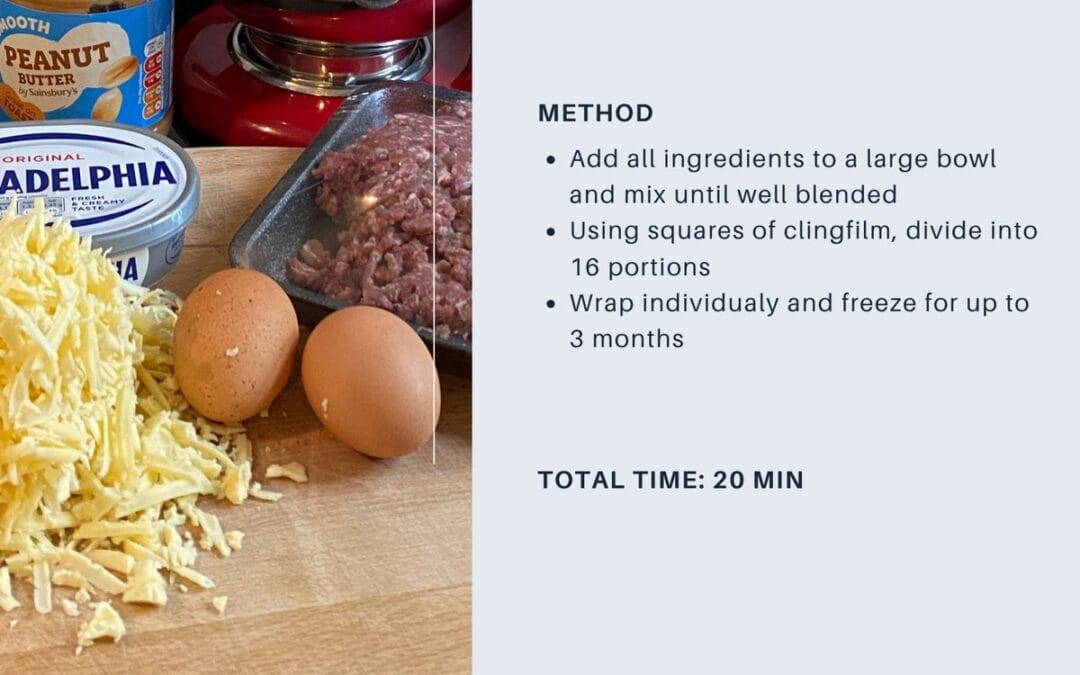
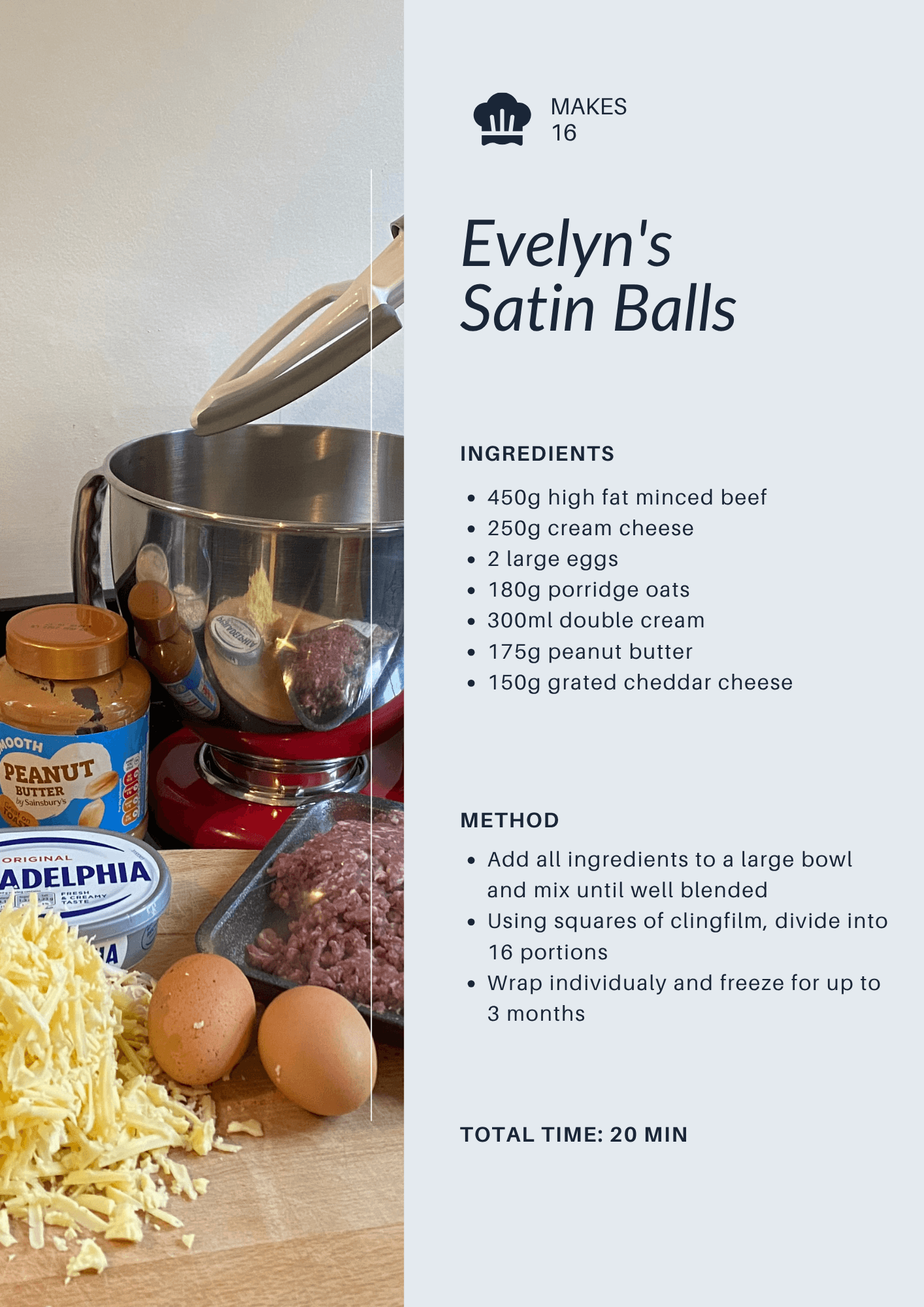
Evelyn’s Satin Balls — makes 16
Ingredients
- 450g high-fat minced beef
- 250g cream cheese
- 2 large eggs
- 180g porridge oats
- 300ml double cream
- 175g peanut butter
- 150g grated cheddar cheese
Method
Add all ingredients to a large bowl and mix until thoroughly combined. Using squares of clingfilm, divide the mixture into 16 equal portions. Wrap each individually and freeze for up to 3 months.
Serve defrosted or partially thawed.
One non-negotiable: check your peanut butter label before you use it. Xylitol — an artificial sweetener found in some reduced-sugar peanut butters — is highly toxic to dogs. Use a plain, natural peanut butter with no sweeteners of any kind.
How to use them
These are a supplement, not a meal replacement. I typically give one or two a day alongside the dog’s normal food, depending on body condition and the reason I’m using them. For a dog in genuine distress or post-illness, I might start with one per day and monitor condition weekly. For a hard-keeping sport dog in heavy training, two a day is reasonable.
They are calorie-dense. Used long-term without adjusting the rest of the diet, you will overshoot the target. Use your eye and your hands — you should be able to feel the last rib with light pressure but not see it. That’s the benchmark.
They’re also not a substitute for investigating why a dog is losing condition. If a dog is dropping weight without an obvious cause — stress, illness, output — a vet check is the right starting point. Parasites, dental pain, underlying disease, and absorption issues all present as weight loss and none of them are solved by Satin Balls.
The practical reality
In 40-plus years of working with dogs — from police dogs to competition sport dogs to rehabilitation cases — the tools that earn a permanent place in your practice are the ones that work reliably and safely in the right situations. This recipe is one of them. It came from someone who had seen more than us, and we’ve passed it on more times than we can remember.
Use it when the situation calls for it. Use it sensibly. And check the peanut butter label.
Want to keep a copy? Download the recipe card to save or print.
About the Author
Paul Flanagan is head trainer at Liberty K9 and a 10-time WUSV IGP World Championship competitor — including 3rd place at the 2013 World Championship and selected for Team Ireland at the 2026 WUSV World Championship in Slovenia — with over 40 years of experience training dogs across sport, pet behaviour and working disciplines. He has successfully rehabilitated hundreds of dogs with serious aggression and behaviour problems. Learn more about the Liberty K9 team.
Related: Residential Dog Training | More from the Blog
You May Also Like…

How to Get Started in IGP Dog Sport in the UK
IGP — formerly known as IPO, and before that Schutzhund — is the triathlon of dog sports: tracking, obedience and...
What Is NePoPo Dog Training? The Method Explained
NePoPo® is a dog training system developed by Bart and Michael Bellon that has become one of the most influential...
Dog Aggression Specialist UK: How to Find the Right Help
If your dog has bitten someone, attacks other dogs, or guards food and space with real intent, you have probably...