

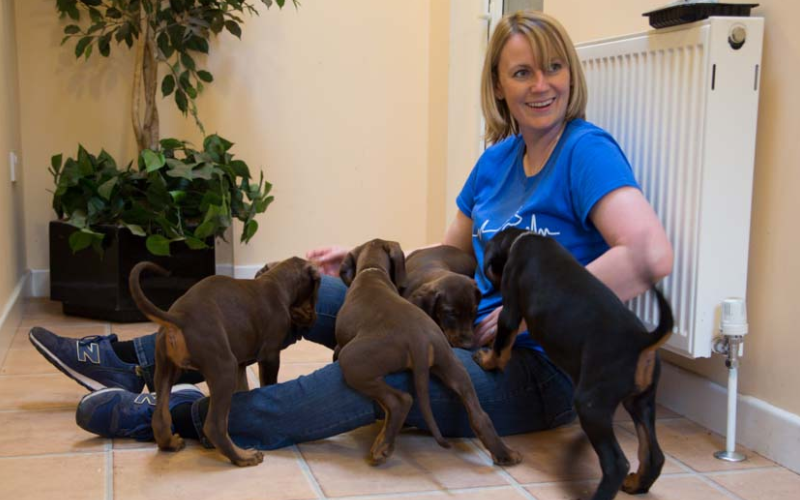
Puppy Training in Cheshire: When Should You Start?
Puppy Training in Cheshire: When Should You Start?
The most common mistake puppy owners make is waiting. Waiting until the puppy is older, waiting until the behaviour problems feel urgent enough. By the time most puppies arrive for their first training session, they have already been practising the wrong things for weeks.
The critical socialisation window
Between roughly three and twelve weeks old, puppies are in what behaviourists call the critical socialisation period. The brain is particularly receptive to new experiences during this time, and the habits and associations formed here tend to be the most durable.
A puppy exposed to different people, environments, sounds and animals during this window develops a solid foundation. A puppy that spends this time in a limited environment is much more likely to develop fear and reactivity problems later. You cannot fully compensate for a missed socialisation window. As Dogs Trust notes, you can improve things, but you cannot replicate it.
Starting from ten weeks
We work with puppies as soon as their vaccinations are complete. The idea that puppies cannot begin learning until they are six months old is outdated and, frankly, harmful.
At this stage, a puppy is capable of learning basic commands and starting to understand what the world expects of them. More importantly, they are at an age where structured, calm guidance shapes who they become rather than trying to override habits that are already well established.
What early training actually covers
Good puppy training at this stage is not just about sit and stay, though those matter. It covers how your puppy relates to you and other people. How they respond to being handled. Their behaviour at the door when visitors arrive. How they walk on lead before pulling becomes the default. Recall, before the habit of running off is established. Crate and settle training. Mouthing and nipping, before bite pressure becomes a problem.
These are the foundations that everything else is built on. Getting them right at eight to twelve weeks is straightforward. Getting them right at twelve months, once the habits are established, is considerably harder.
The cost of leaving it too late
Most of the serious behaviour problems we see at Liberty K9 have their roots in the puppy period. Not because the owners did not care, but because they did not realise that the early weeks were the window that mattered most.
A puppy that jumps up and mouths at eight weeks is entertaining. At eighteen months and 40 kilograms, the same behaviour is a serious problem. The gap between those two states is not a change in the dog’s behaviour. It is the same behaviour in a larger, stronger body.
Puppy training at Liberty K9 in Cheshire
We offer two routes. A two-week residential foundation programme where your puppy lives and trains with us from the start. Or a series of private one-to-one lessons where you attend our facility at Gate Farm, Nantwich alongside your puppy and learn the techniques yourself.
Both options start from the point vaccinations are complete. Both give your puppy a clear, confident foundation rather than leaving you to deal with problems later.
If you are looking for dog training in Cheshire and want to discuss what would work best for your puppy, get in touch here.
About the Author
Paul Flanagan is head trainer at Liberty K9 and a 10-time WUSV IGP World Championship competitor — including 3rd place at the 2013 World Championship and selected for Team Ireland at the 2026 WUSV World Championship in Slovenia — with over 40 years of experience training dogs across sport, pet behaviour and working disciplines. He has successfully rehabilitated hundreds of dogs with serious aggression and behaviour problems. Learn more about the Liberty K9 team.
Starting out with a puppy? The habits formed in the first few months are the ones you live with for the next decade, and early foundations are far easier than later corrections. Take a look at our puppy foundation training, or tell us about your puppy and we will help you make a plan.
Related: Puppy Training Foundation | Book a Consultation | Puppy Biting
You May Also Like…
How Much Does One-to-One Dog Training Cost in the UK?
There's no standard price for private dog training, and that's what makes it awkward to compare. Trainers charge by...

How to Stop Your Dog Pulling on the Lead
Pulling is the most common thing people complain to us about, and the reason is simple. Pulling works. Every time your...

Dog Recall Training: How to Get Your Dog to Come Back
A good recall is the thing most owners want and the thing most struggle with. Your dog comes back beautifully in the...
About the Author
Paul Flanagan is head trainer at Liberty K9 and a 10-time WUSV IGP World Championship competitor — including 3rd place at the 2013 World Championship and selected for Team Ireland at the 2026 WUSV World Championship in Slovenia — with over 40 years of experience training dogs across sport, pet behaviour and working disciplines. He has successfully rehabilitated hundreds of dogs with serious aggression and behaviour problems. Learn more about the Liberty K9 team.
Related: Dog Aggression Training | Book a Consultation